Open hardware, open evidence

A God Helmetyou can build,and test blind.

Eight weak-field coils on a headband, an ESP32, and this app. It plays the signals Persinger’s laboratory and its imitators used, and gives you sham sessions you cannot tell apart from real ones, so you can find out whether the field does anything to you.

The demo runs the helmet’s engine in your browser. No hardware, nothing to install.

Playing, 10× slower: God Helmet classic (Persinger 2-phase). Phase 2 of 2: Accelerating burst 6 → 30 Hz, 0.87 s on, 4 s off, 3 ms points. Stepping around both sides at once (left clockwise, right counter-clockwise), 125 ms per coil.

198
programs, each labelled with the evidence behind it
30
guided sessions with audio and questionnaires
8
coils, driven together 2,000 times a second
1–8µT
at the cortex: about a million times weaker than TMS

Honest expectations

The fields are about 1–8 µT at the cortex, about a million times weaker than TMS, and the induced electric field is microvolts to millivolts per metre. The best double-blind test (Granqvist 2005, N = 89) found no effect of the field; suggestibility predicted the experiences.

That is why the blinding is built into the helmet and not left to the person wearing it: so that what you find out is about the field, and not about what you hoped for.

Read the evidence review

What you can do with it

Everything here runs in the demo too, with the helmet’s engine in your browser and nothing switched on.

198 programs

Todd Murphy’s Shiva and Shakti sessions on their exact 10-10 sites, 38 Persinger-lab protocols, the timing of clinical low-field methods, and replications of the independent tests. Each one states the evidence for the original and what it approximates.
Sweep 40 → 6 Hz over 2.51 s, 1.49 s pauseRight hemisphere chirp, counter-clockwise
Browse the programs

Blind sessions

Tick Blind and the helmet picks real or sham at random. The coil display is hidden, and you learn which it was only after you have rated the session.

How the blinding works

Committed trials

Remote-viewing and telepathy trials where the target is fixed, and provably so, before you respond.

Open the trials

30 guided sessions

Step-by-step sessions with binaural, monaural or isochronic audio, questionnaires, and a blinded helmet arm where the guide calls for one.

Left ear, 200 HzRight ear, 204 HzTogether: a 4 Hz beat
See the guides

Where the field reaches

A weak field falls off fast. Every program shows an estimate of it at each brain region, for every phase.

At 20 mm below the coil1.0 µT

8 mma program's strength is set at 20 mm80 mm
See it on the brain

From putting it on to knowing what it was

  1. Place the coils

    Each program names its eight 10-10 sites. The app turns them into tape-measure directions in centimetres for your head, and a checklist to tick off coil by coil.

  2. Pick a program

    Every program page shows its phases, the signal in each one, which coils run when, where the field reaches in the brain, and the sources it was built from.

  3. Start it, blind if you like

    The Start panel lists what is ready and what is not. Tick Blind and the helmet decides, out of your sight, whether this session is real or sham.

  4. The helmet runs it

    The helmet plays the session by itself and keeps going if the phone disconnects. In a blind session the coil display stays dark either way.

  5. Rate it, then see what it was

    You rate the session before anything is revealed. Only then does the helmet tell you whether the field was on. Do that a few dozen times and you have your own answer.

How it is built

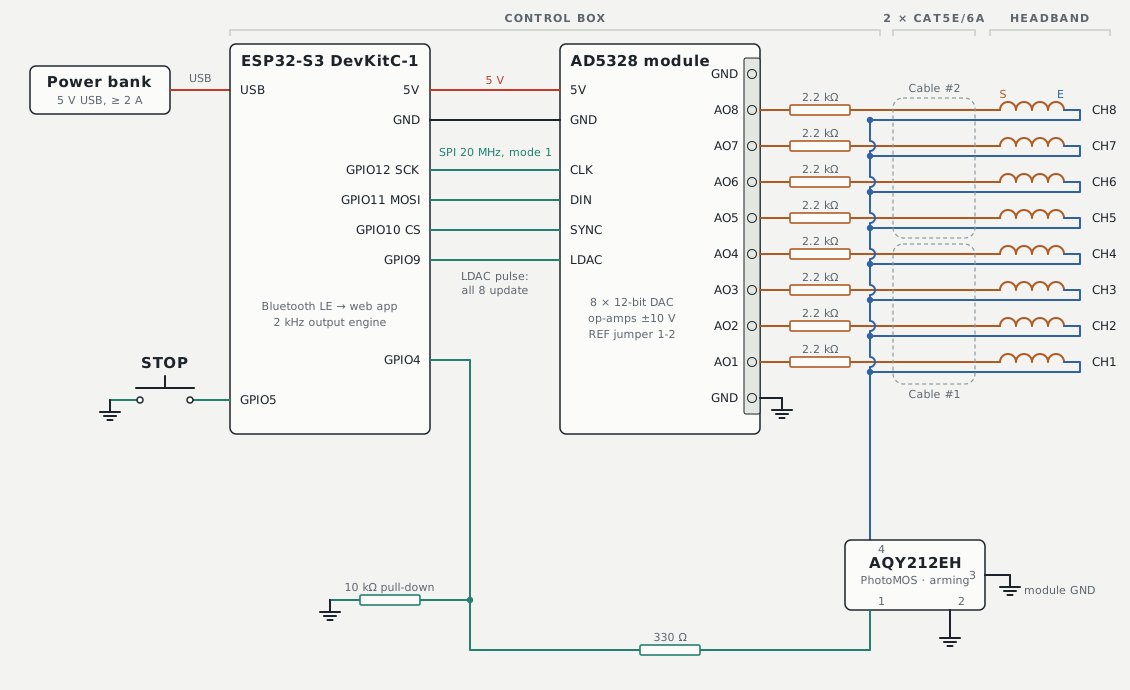
A control box, two network cables and a headband. Everything is in the repository: firmware for five boards, the schematic, the parts list and a printable coil clip.

Controller
ESP32-S3, classic ESP32, C3 or C6. Updates all eight coils together at 2 kHz and keeps a session running if the phone disconnects.
Output
AD5328 8-channel ±10 V DAC, a 2.2 kΩ series resistor per coil, and a PhotoMOS arming switch.
Coils
Eight small coils on a Velcro headband, placed on 10-10 sites with a tape measure.
Power
A USB power bank. Never mains while the helmet is worn.
Control
This app over Bluetooth LE or a USB cable, or a 2.8" touchscreen board with a microSD card.

Read the safety page first

Not for people with epilepsy or seizure history, psychiatric conditions, or implanted electronics. Battery power only. Experimental, non-medical.

The helmet refuses to start a field until the safety page has been accepted on it, and it has a STOP button, an arming switch, a field ceiling and a 60-minute cap.

Safety

Where the project stands

Verified

  • All five firmware targets build
  • Host unit tests pass
  • The JavaScript engine reproduces the C++ engine’s output for every program
  • Protocol, blind reveal and trial commitment logic are tested against the demo helmet

Not yet verified on hardware

  • Bluetooth with a real phone
  • The DAC module’s transfer function
  • SPI and LDAC timing
  • The coils’ real µT per mA

Calibration walks through them.

Find out for yourself.

Open the demo, pick a program, and run it blind. It takes two minutes and no hardware.