God Helmet: 8-coil weak-field headset (ESP32 + AD5328 + web app over Bluetooth or USB)
What the project is, what is in the repository, quick start and current status.
7 min readSource on GitHub
A DIY recreation of the Persinger/Koren "God Helmet", the 8-coil Shakti and the circumcerebral "Octopus":
- 8 small coils on a Velcro headband;
- an AD5328 8-channel ±10 V DAC;
- an ESP32 that runs the signals in real time: ESP32-S3, classic ESP32, ESP32-C3 or ESP32-C6, without a display;
- a Vue web app on GitHub Pages that connects over Bluetooth LE or a USB cable, and installs the firmware;
- or, without phone or computer, a 2.8" touchscreen board that runs the programs from its microSD card (docs/STANDALONE.md).
It ships 198 programs built from fact-checked research: Todd Murphy's Shiva and Shakti sessions on their exact 10-10 sites (with reversed-polarity coils where the Shakti wiring needs them), 38 Persinger-lab protocols (sensed presence, Thomas pulse, circumcerebral rotations, Swann remote viewing, telepathy), the timing of clinical low-field methods (LFMS, T-PEMF, Cnp, theta-burst, BHFS), and replications of the independent tests. Each program states the evidence for the original protocol and what it approximates. Each program's page also has a Brain tab that shows where each program's field goes on a 3D brain, 30 guided sessions with beat audio and questionnaires, and the means to test it all honestly:
- blinded real/sham sessions;
- hash-committed, blind-judged remote-viewing and telepathy trials with exact statistics.
Read docs/SAFETY.md first. Not for people with epilepsy or seizure history, psychiatric conditions, or implanted electronics. Battery power only. Experimental, non-medical.
Honest expectations. The fields are about 1–8 µT at the cortex, about a million times weaker than TMS, and the induced electric field is microvolts to millivolts per metre. The best double-blind test (Granqvist 2005, N = 89) found no effect of the field; suggestibility predicted the experiences. See docs/RESEARCH.md.
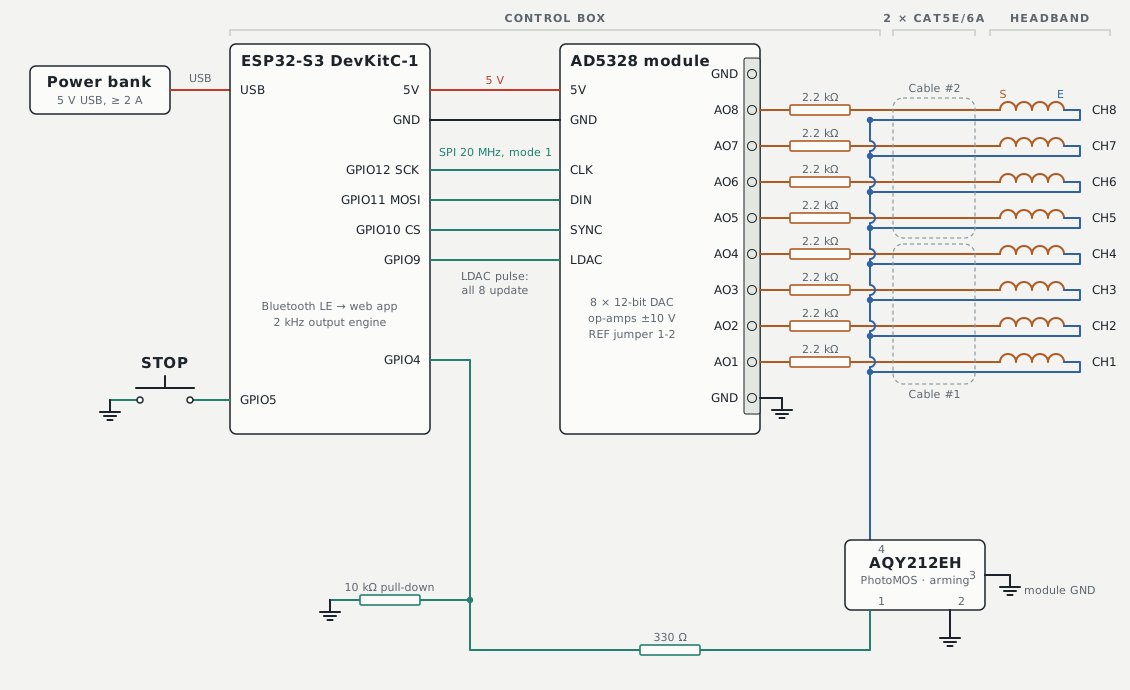
How it fits together
 phone / laptop browser                     control box                                  headband
 ┌──────────────────────┐ Bluetooth / USB┌──────────────┐  SPI + LDAC  ┌──────────┐ 2.2 kΩ ×8  ┌─────────┐
 │ web app (GitHub      │◄──────────────►│  ESP32       │─────────────►│ AD5328   │──────────► │ 8 coils │
 │ Pages): programs,    │  JSON-RPC +    │  2 kHz engine│              │ ±10 V ×8 │◄─ returns ─│         │
 │ placement, trials    │  live status   │  log, trials │  PhotoMOS ◄──┤          │  PhotoMOS  └─────────┘
 └──────────────────────┘                └──────────────┘  STOP button └──────────┘
- The app (tabs: Programs, Guides, Trials, Log, Helmet, Docs) holds:
- the program library, searchable, browsed by category, by placement (all 54 placements in use), by scalp site (a site explorer for every 10-10 site) or by the experience a program aims at;
- a page for each program with tabs:
- Overview: phases, waveforms and an in-browser preview of the coil activity;
- Placement: the coils on a head map from above and from both sides, and a coil-by-coil checklist with tape-measure directions in centimetres for your head;
- Brain: estimated field per brain region (cored-coil model on the Brainnetome and CerebrA atlases), what electrode or TMS stimulation of each region produced, and the claims made for it;
- Sources: the evidence level and the sources;
- a Start panel on each program page that lists what is ready (connection, safety page, head measured, coils placed, calibration, time since the last session);
- guided sessions (Gateway-style, remote viewing, ESP training, sleep) with binaural, monaural or isochronic audio, a blinded helmet arm and questionnaires;
- blinded remote-viewing and telepathy trials with their picture pool (Trials), and calibration, the wiring check, settings and firmware install (Helmet);
- all documentation (the Docs tab renders
docs/*.mdand a reference of every program).
It has a demo mode that runs the same engine in the browser, so everything can be explored without hardware. - The helmet holds:
- the real-time engine, with all 8 coils updated together at 2 kHz;
- the hidden blind choices (real/sham, RV target, with SHA-256 commitments);
- the session and trial log;
- the safety interlocks: STOP button, arming switch, field ceiling, 60-min cap.
A running session continues if the phone or computer disconnects, and the app shows it again when it reconnects. If the helmet itself restarts, the session's log entry says why and how long it ran.
What's here
| Path | Contents |
|---|---|
| docs/RESEARCH.md | The evidence review: Persinger lab, independent tests, Murphy's claims, mainstream low-field science, psi evidence, states → brain regions → helmet protocols, lecture notes |
| docs/HISTORY.md | Military, intelligence and health-agency history: ELF research, remote-viewing programmes, Gateway, the replication controversy, WHO/IARC/ICNIRP |
| docs/EFFECT_SENSED_PRESENCE.md, docs/EFFECT_OUT_OF_BODY.md, docs/EFFECT_REMOTE_VIEWING.md | Articles on the three most reported effects: what people report, the lab record and independent tests, the science without a helmet, checked YouTube videos, reading lists and how to test each with this helmet |
| docs/SIGNALS.md | What the coils play: coil physics and ICNIRP compliance, the Persinger-lab signals rebuilt from primary sources, Murphy's signal families, clinical timings |
| docs/PRESET_FORMAT.md | The program file format, every signal and coil mode, the pulse-table generators, the preset checker |
| docs/BRAIN_VIEW.md | How the brain view's field map is computed, its accuracy, data and licences |
| docs/GUIDES.md, docs/QUESTIONNAIRES.md | Guided-session format, audio engine, questionnaires and scoring |
| docs/WIRING.md | Schematic, coil leads (inner = signal, outer = return), pin tables (S3, classic ESP32, C3, C6, 2.8" display board), arming switch, Cat6A pair mapping |
| docs/STANDALONE.md | The 2.8" touchscreen board without the app: flashing, the SD-card program pack, clock, screens |
| docs/PLACEMENT.md | The 10-10 system, finding sites with a tape measure, the standard and program-specific layouts, depth and field per target |
| docs/CALIBRATION.md | Bench test of the module, wiring checks, µT/mA calibration with a phone |
| docs/EXPERIMENTS.md | Blinded sessions, remote-viewing and telepathy protocols, statistics |
| docs/BLE_PROTOCOL.md | GATT service, framing, the USB line protocol, operations, session JSON, trial commitment |
| docs/SAFETY.md | Contraindications, rules, built-in safeguards |
| presets/ | The 198 programs (JSON), shared by the app and the firmware tests |
| guides/ | The 30 guided sessions (JSON) |
| firmware/ | PlatformIO project: engine, Bluetooth and USB transports, experiments, log |
| webapp/ | Vue 3 + Vite app, deployed to GitHub Pages by .github/workflows/pages.yml |
| hardware/ | Bill of materials, coil clip (OpenSCAD), schematic generator |
| tools/ | Python: coil field estimate, point tables, WAV → table, calibration fit, trial statistics; Node: brain-view asset builder |
Quick start
Supported boards
| Board | Chip | Bluetooth | USB | Display | Firmware env |
|---|---|---|---|---|---|
| ESP32-S3-DevKitC-1 (N8R8 / N16R8, 8 MB flash) | ESP32-S3 | yes | yes | – | esp32s3 |
| ESP32 DevKitC (WROOM-32, 4 MB) | ESP32 | yes | yes | – | esp32dev |
| ESP32-C3-DevKitM-1, C3 Super Mini (4 MB) | ESP32-C3 | yes | yes | – | esp32c3 |
| ESP32-C6-DevKitC-1 and other C6 boards (4 MB or more) | ESP32-C6 | yes | yes | – | esp32c6 |
| 2.8" ESP32-32E display board | ESP32 | optional | yes | touchscreen | esp32e_lcd28 |
Pins for each board: docs/WIRING.md.
Install from the app (no other software): Helmet → Install the firmware, in Chrome or Edge on a computer, with the board on USB. It recognises the chip and asks before erasing.
Firmware (PlatformIO):
cd firmware
./test/run_host_tests.sh      # engine, JSON, BLE framing, every preset rendered at 2 kHz
pio run -e esp32s3 -t upload  # ESP32-S3-DevKitC-1 (-e esp32dev, -e esp32c3, -e esp32c6; -e esp32e_lcd28: 2.8" display board)
pio device monitor            # prints the Bluetooth name, e.g. GodHelmet-3F2A
scripts/web_bundle.sh ../webapp/public/firmware   # images + manifests for the app's installer (CI does this)
Standalone touchscreen board: pio run -e esp32e_lcd28 -t upload, then npm run sd-pack -- <dir> in webapp/ for the SD card (docs/STANDALONE.md).
App:
cd webapp
npm install
npm test                      # JS engine matches the C++ engine; field model; guides; protocol and trial logic
node scripts/check-preset.mjs --all   # validate every program file
node scripts/table.mjs list            # exact pulse tables (theta-burst, Thomas, LFMS, ...)
npm run dev                   # http://localhost:5173 (Web Bluetooth and Web Serial work on localhost)
Deploy: push to GitHub, then Settings → Pages → Source: GitHub Actions. The app appears at https://<user>.github.io/<repo>/.
First use:
- Open the app in Chrome/Edge (iPhone: Bluefy) and press Bluetooth, or plug the helmet into the computer and press USB.
- Read and accept Safety.
- Do the bench test and calibration (docs/CALIBRATION.md) before wearing the helmet.
Status
- Verified here:
- all five firmware targets build;
- host unit tests pass;
- the JavaScript engine reproduces the C++ engine's output for every preset (whole sessions plus a 3.5 ms-resolution window);
- protocol, blind reveal and trial commitment logic are tested against the demo helmet;
- the app builds and runs in a headless browser in demo mode.
- Not yet verified on hardware:
- BLE with a real phone;
- the module's transfer function;
- SPI/LDAC timing;
- the coils' real µT/mA.
docs/CALIBRATION.md walks through them.